
Appearance of the Japanese Spitz – Conformation, Coat and the FCI Breed Standard
The Japanese Spitz is one of those breeds you recognise at first glance: a snow-white coat that stands away from the body, a fox-like face and triangular, erect ears. But recognising a Japanese Spitz is one thing; assessing whether the dog before you truly conforms to the breed standard is another. That distinction rests on a document most owners have never heard of: the official breed standard, FCI Standard No. 262. In this chapter, we do not simply want to list what a Japanese Spitz should look like. We want to show you something you will not find in popular articles about the breed: what a breed standard really is, why the same dog may be described differently in different countries, and what a breeder sees when looking at a Japanese Spitz. That is an entirely different perspective from simply admiring a small, white, fluffy dog.
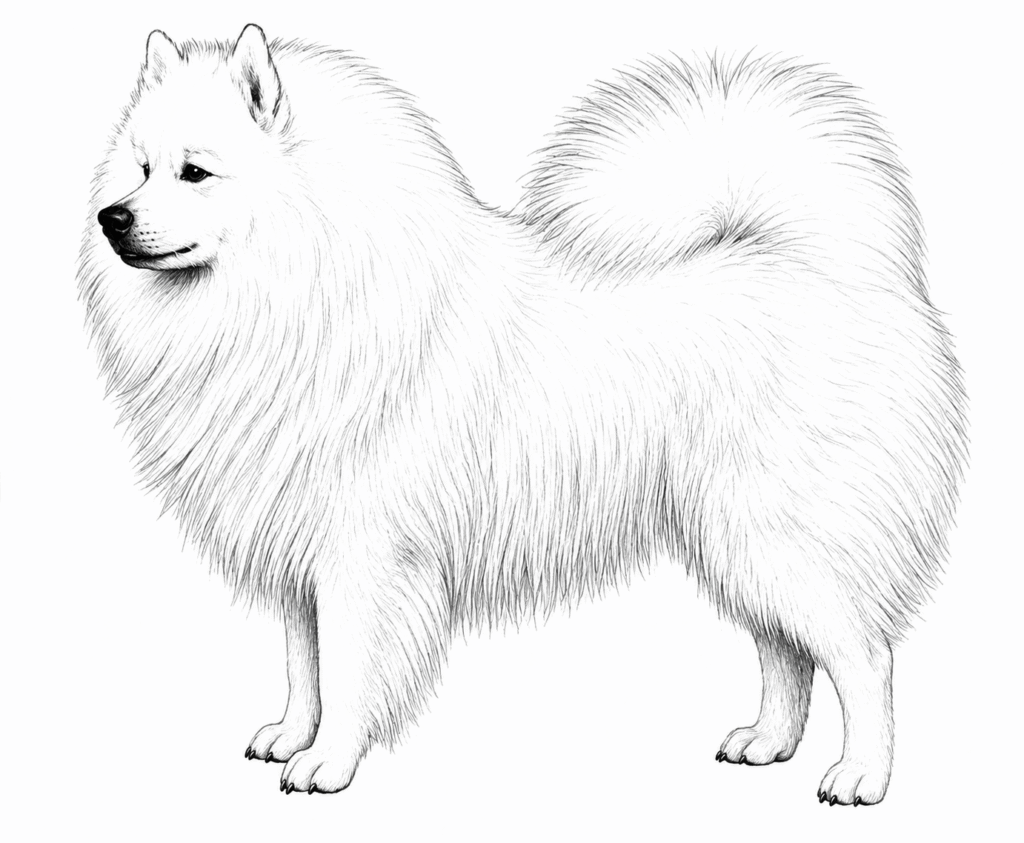
Appearance at a Glance – Key Points from the FCI Breed Standard
- Body proportions: slightly longer than tall, with a height-to-body-length ratio of 10:11
- Height at the withers: males 30–38 cm; females slightly smaller
- Coat: double, with a stand-off outer coat and a dense, soft undercoat
- Colour: pure white only
- Ears: small, triangular, erect, set high
- Tail: set high, carried over the back
- Bite: scissor bite, with strong, white teeth
What Exactly Is a Breed Standard?
Contrary to what you might think, a breed standard is not a checklist of attractive features or a collection of judges’ whims. It is a written description of the ideal dog – a blueprint that guides how the breed should be developed. Most importantly, its purpose is not simply to make a dog look beautiful, but to preserve health, sound conformation and true breed type from one generation to the next.
That is why a breed standard covers everything: from body proportions and the shape of the head to limb alignment, temperament and movement. Each of these elements serves a functional purpose. Erect ears, a black nose, springy movement and a stable temperament are not merely decorative details; they are characteristics that define the breed and reflect its health and soundness.
A breed standard also embodies another principle whose importance becomes clearer with experience: moderation. The British standard states it plainly: even a desirable characteristic should be present only to the correct degree. In other words, exaggeration is a fault, not a virtue. This is how the standard protects a breed from passing fashions and the pursuit of extremes – trends that have led to health problems in many breeds. For us as breeders, the standard is a constant point of reference. We assess every one of our dogs against it before we even consider a particular mating.
One Breed Standard, Different Countries – Where Do the Differences Come From?
This brings us to something rarely explained on Polish websites about the breed. A breed standard originates in the breed’s country of origin. The Japanese Spitz originated in Japan, and the standard developed by the Japan Kennel Club forms the basis of FCI Standard No. 262, published by the Fédération Cynologique Internationale (FCI). Put simply, the FCI standard reflects the Japanese standard, while the document used by the Polish Kennel Club (ZKwP) is its Polish translation. So when you read the Polish version, you are still hearing the breed described in the voice of its homeland.
However, countries with strong kennel traditions also produce their own breed standards. The Royal Kennel Club in the United Kingdom, Dogs New Zealand and the United Kennel Club (UKC) in the United States all describe the same breed somewhat differently – rather like dialects of a single language. The meaning remains the same, but the emphasis shifts. Nowhere is this clearer than in one measurement: height at the withers.
| Parameter | FCI (and ZKwP) | The Royal Kennel Club (UK) | Dogs New Zealand |
|---|---|---|---|
| Height at the withers – males | 30–38 cm | 34–37 cm | 30–40 cm |
| Height at the withers – females | Slightly smaller than males | 30–34 cm | 25–35 cm |
| Height-to-body-length ratio | 10 : 11 | 10 : 11 | Not specified |
This table tells a story of its own. The FCI gives a broad height range for males but describes females only in general terms as “slightly smaller”. The British standard is both the most precise and the narrowest, setting separate height ranges for males and females. The New Zealand standard takes the opposite approach, allowing the tallest males and the smallest females of all the standards compared here. For completeness, Australia follows the British standard, so its requirements are the same as those in the UK, while the United Kennel Club in the United States remains close to the FCI standard. Taken together, these differences create a map of how the breed has been interpreted around the world: born in Japan, defined more narrowly in Britain and given a broader height range in New Zealand. This is the kind of insight that comes from reading the standards themselves, rather than a typical overview of the breed.
The Appearance of the Japanese Spitz Through a Breeder’s Eyes
Now that we understand what a breed standard is and why its wording can vary from country to country, let us examine the dog itself – through a breeder’s eyes rather than as a dry checklist of features. Every point in the standard is there for a reason.
Head – the Hallmark of the Breed
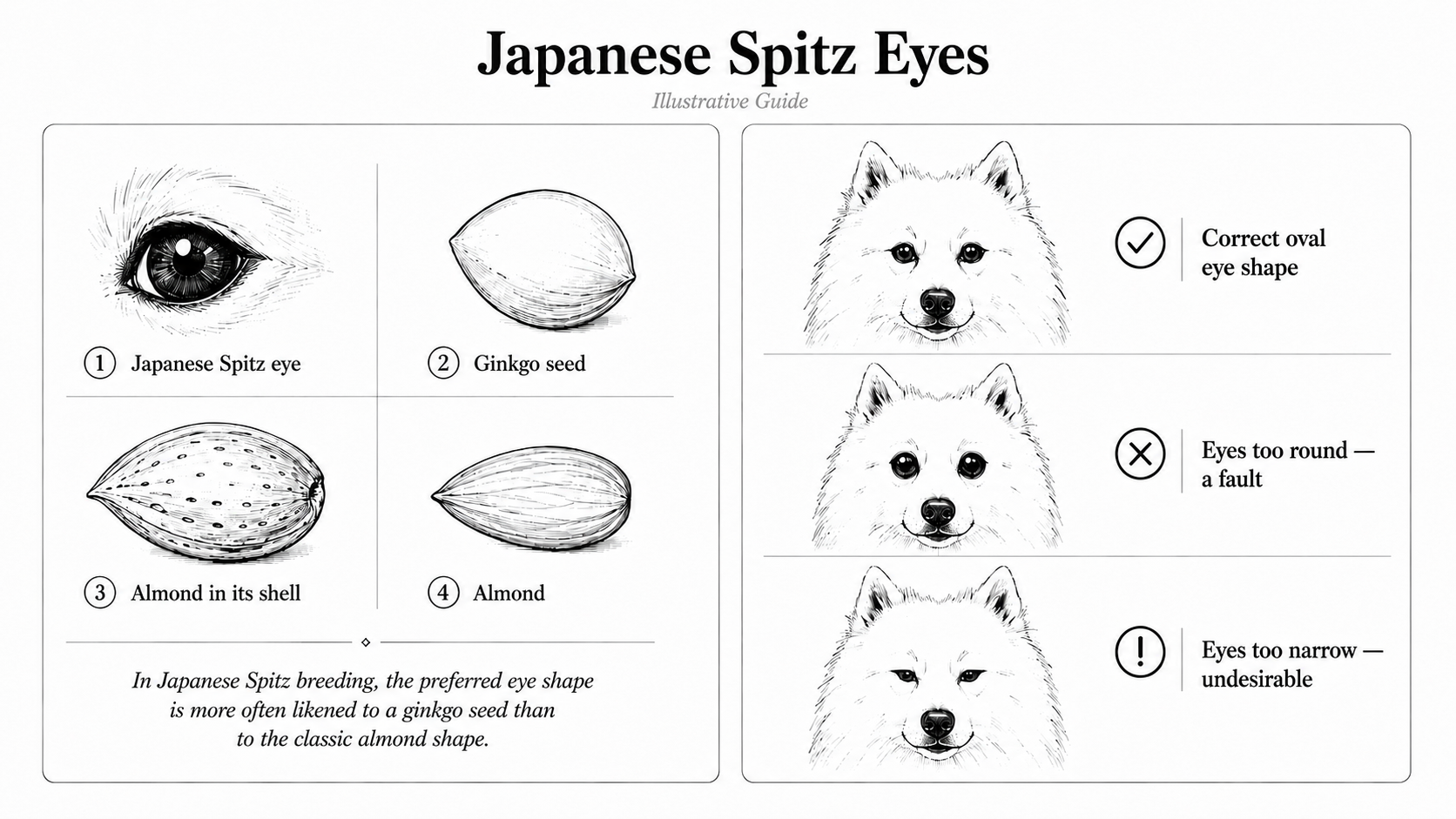
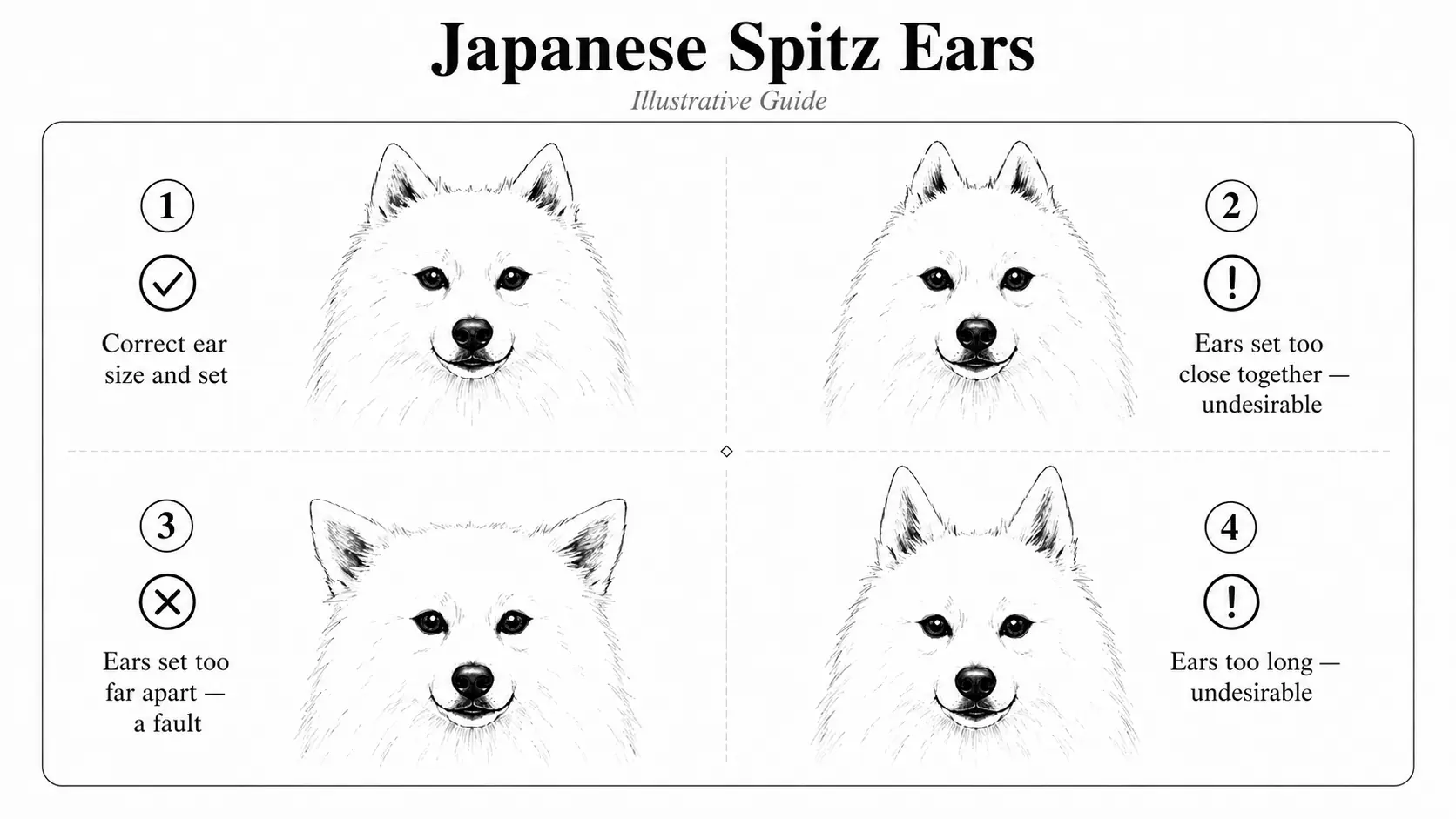
The head reveals more about breed type than any other feature. The skull is moderately broad and rounded, widest at the rear, with a clearly defined but never exaggerated stop. The muzzle tapers to a point, but the tip itself is slightly rounded rather than sharp, creating the characteristic fox-like expression. The nose is small, round and black. The eyes are dark, moderately large and set slightly obliquely, with black eye rims. Although the FCI describes them as almond-shaped, the term “ginkgo eyes”, used by breeders, captures their type more precisely. They should not resemble a narrow, sharply pointed almond, but should have a softly oval, slightly elongated shape reminiscent of a ginkgo seed. The contrast of the black nose and dark eyes against the snow-white coat gives the Japanese Spitz its alert, intelligent expression. The ears are small, triangular, firmly erect and set high. In an adult Japanese Spitz, they must not droop: drop ears are a disqualifying fault under the FCI standard.
Body Shape, Limbs and Movement
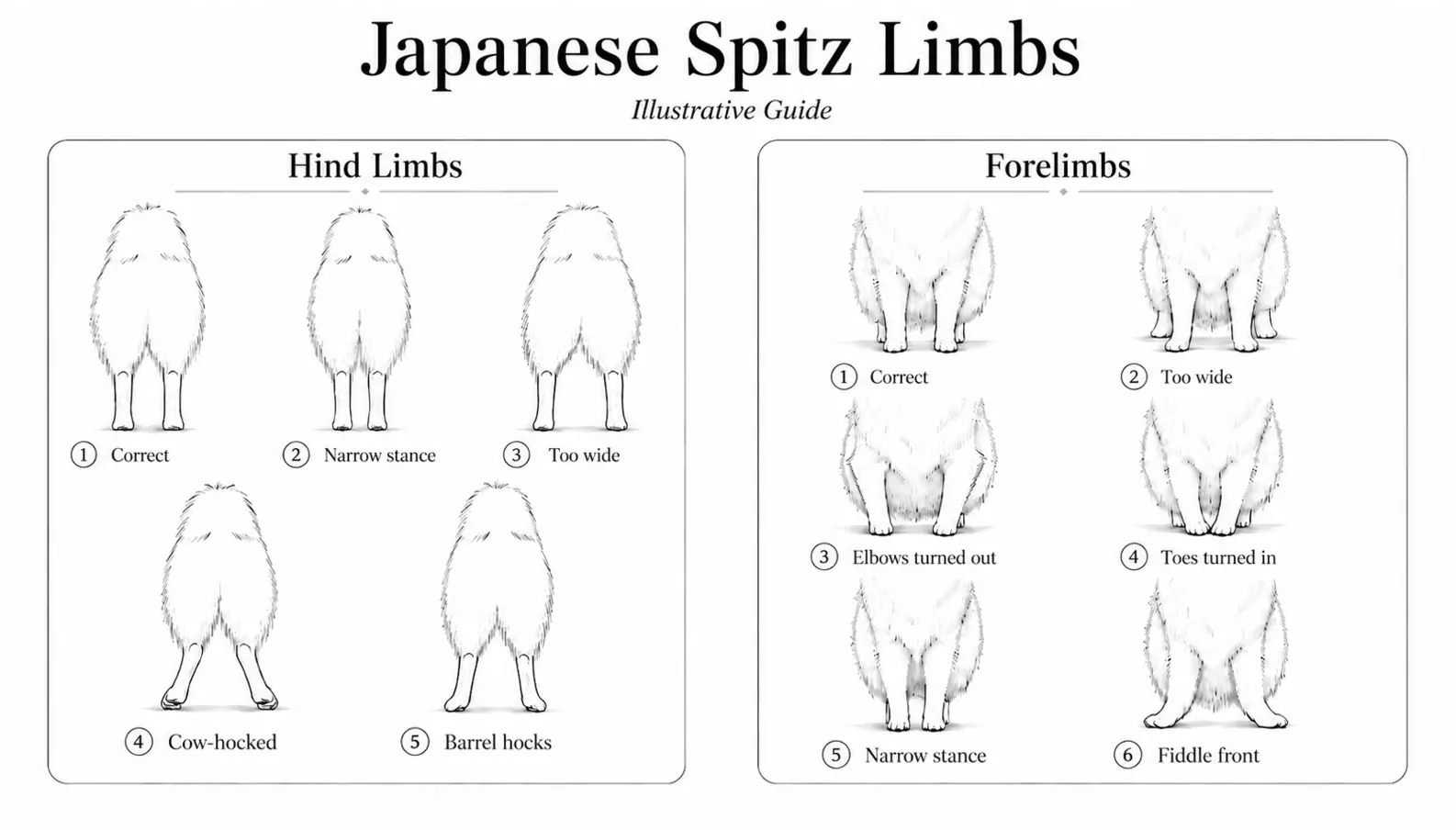
A height-to-body-length ratio of 10:11 means that the Japanese Spitz is slightly longer than it is tall, giving it a compact, well-balanced outline rather than a slender or elongated one. The neck is moderately long and well muscled, the back straight and short, and the chest broad and deep, with well-sprung ribs. The body should be strong and well knit, yet clean in outline and never heavy. The feet are cat-like and compact, with thick pads, while the limbs are moderately angulated. In motion, a well-constructed Japanese Spitz should be quick and active. English-language standards further describe the gait as light, nimble, smooth and flowing – almost as though the dog were barely touching the ground. This is no mere lapdog, but an active breed built to move.
Tail
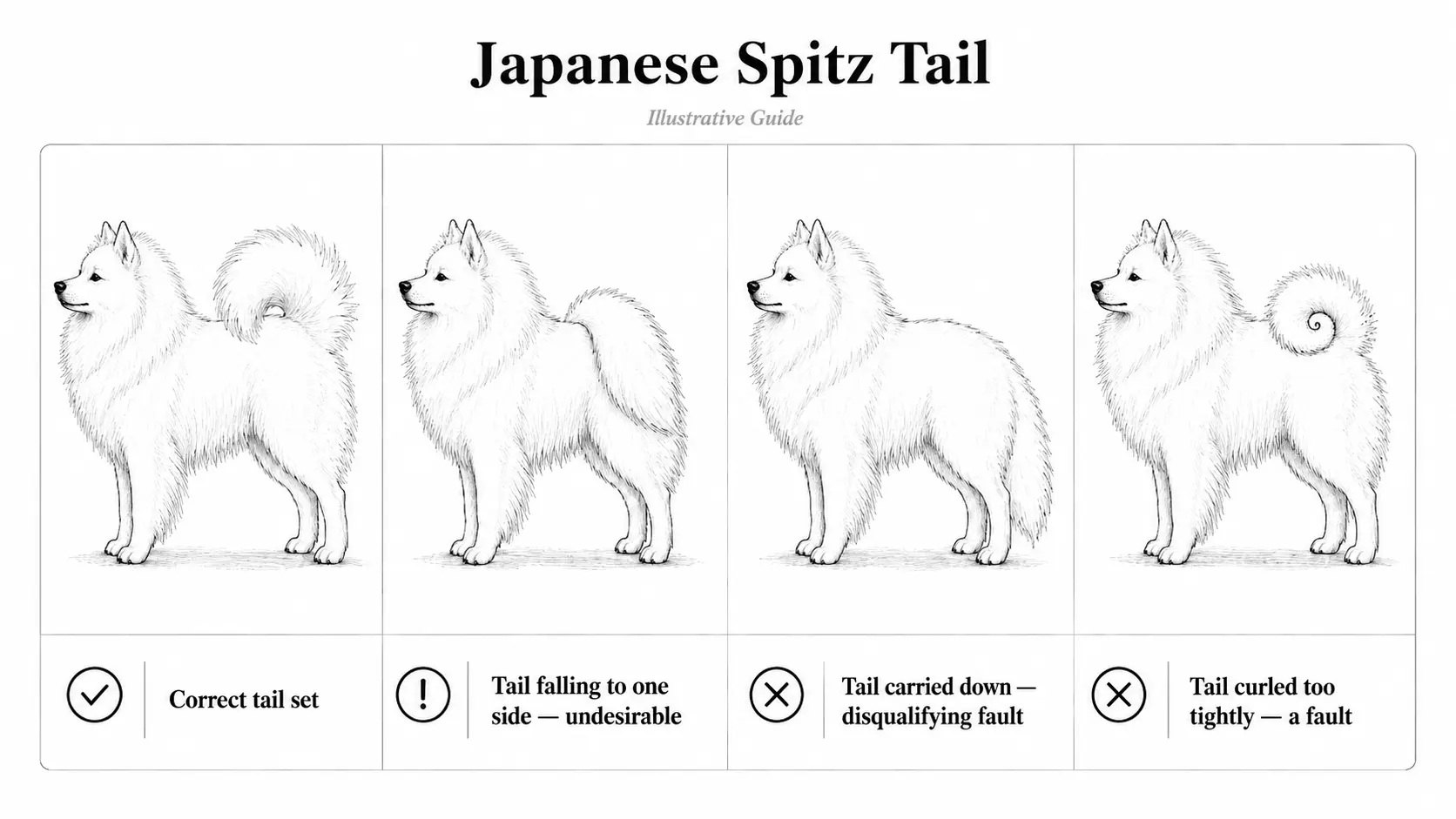
The tail deserves separate attention, because this is where the standards begin to differ subtly. It is set high, profusely feathered and carried over the back – the plume draped across the back is one of the breed’s most recognisable silhouette features. Interestingly, the FCI simply states that the tail is “carried over the back”, whereas the British standard describes it as “carried curved over the back” and the New Zealand standard as “curled over the back”. It may seem a minor detail, but it again shows how different kennel organisations place emphasis on slightly different aspects of the breed.
The Snow-White Coat
Finally, there is the coat – the feature that catches the eye first. It is a double coat: the outer coat is straight and stands away from the body, with a short, soft and dense undercoat beneath. The hair is short on the muzzle, ears and fronts of the legs, while the rest of the body is covered with an abundant long coat. Around the neck and shoulders, it forms a luxuriant ruff extending down to the brisket, giving the Japanese Spitz its lion-like, stately outline. As for colour, the breed standards leave no room for interpretation: only pure white is permitted, and the British standard states this explicitly – any other colour or combination of colours is unacceptable. We discuss what this white coat is like in everyday life, and how to care for it, in a separate chapter on grooming.
What the Breed Standard Does Not Say – and What It Leaves to the Breeder
We would now like to share something that only becomes apparent after years of working with the breed. In some areas, the breed standard is precise; in others, it is deliberately silent – and what it leaves unsaid is where the breeder’s experience and judgement come into play.
The clearest example is weight. None of the standards – FCI, British or New Zealand – specifies how much a Japanese Spitz should weigh. So what is the “correct” weight for a dog of a given height? The document cannot provide the answer. It must be assessed individually by the breeder and vet, based on the dog’s body condition rather than a number on the scales.
The same applies to noisiness. The FCI lists it as a fault, yet every Japanese Spitz is naturally alert and likely to bark when something catches its attention. So where does normal alert barking end and excessive noisiness begin? The breed standard cannot answer that question. It calls for judgement informed by the dog’s breeding line and by how it has been raised and trained from puppyhood. There is also an important distinction between “desirable” and “required”. For example, the standard says that black nails are desirable, but it does not require them. This leaves room for judgement, and the breeder must decide which traits should take priority in a particular mating.
All of this leads to one conclusion: the breed standard describes the ideal, but it cannot rear puppies or run a breeding programme. The document is the map; it is the breeder who must navigate the terrain. That is why, when choosing a puppy, it matters so much who bred and raised it – not merely how it looks in a photograph.
What the Breed Standard Does Not Permit
Finally, we come to faults – one of the most important parts of the breed standard for a breeder, yet one that popular sources rarely discuss. The FCI lists faults including an overshot or undershot bite, a strongly curled tail, shyness and noisiness. It then identifies disqualifying faults: aggression or excessive shyness, any clear physical or behavioural abnormality, drop ears and a tail not carried over the back. These provisions show where the standard draws firm boundaries – particularly around stable temperament, erect ears and correct tail carriage. However beautiful and snow-white a dog may be, drop ears or a tail that is not carried over the back represent clear departures from the breed ideal.
A breed standard is not mere bureaucracy; it is a written record of what a Japanese Spitz should be, designed to preserve the breed’s health, type and character for generations to come. Every dog in our breeding programme is assessed against it. If you would like to explore other aspects of the breed – including its temperament, the care of its white coat and its health – return to our Japanese Spitz guide. If you are considering a puppy, find out how to choose a responsible breeder registered with an FCI-affiliated kennel club and discover our litters.
Sources and References
This article’s description of the Japanese Spitz’s appearance and breed standard is based on official breed standards published by national and international canine organisations:
- FCI Standard No. 262 – Japanese Spitz (English version, PDF) – the official breed standard published by the Fédération Cynologique Internationale, based on the Japanese breed standard.
- FCI Breed Standard No. 262 – Japanese Spitz (Polish version, PDF) – the Polish translation of the FCI breed standard published by the Polish Kennel Club (ZKwP).
- Japanese Spitz Breed Standard – The Royal Kennel Club – the British breed standard, also used by Dogs Australia.
- Japanese Spitz Breed Standard – Dogs New Zealand – the New Zealand breed standard.
- Marco Piasentin, Japanese Spitz.
- Fédération Cynologique Internationale, FCI Standard No. 262 – Japanese Spitz / Nihon Supittsu.
- Original work by Byakko Kitsune FCI, based on official breed standards, canine literature and our own breeding experience.