
Feeding the Japanese Spitz – Diet, Food and Portions in Our Kennel
Feeding the Japanese Spitz is a subject that almost every new owner asks me about, and I am not surprised. What goes into the dog’s bowl has a major influence on its weight, the condition of its snow-white coat, joint health and everyday wellbeing. I run the Byakko Kitsune kennel and have raised many puppies and adult dogs of this breed, so this article is not simply a collection of information copied from an encyclopaedia. I am sharing what genuinely works for us in everyday life and explaining honestly where textbook rules differ from what I observe in my own dogs.
The Japanese Spitz has a reputation for being a healthy and relatively undemanding breed, and rightly so. However, several of its characteristics mean that feeding still requires careful thought. It is a small breed with a fast metabolism, a clear tendency to gain weight, a fairly sensitive stomach and a coat that quickly reveals dietary mistakes. Let us consider each of these points in turn.
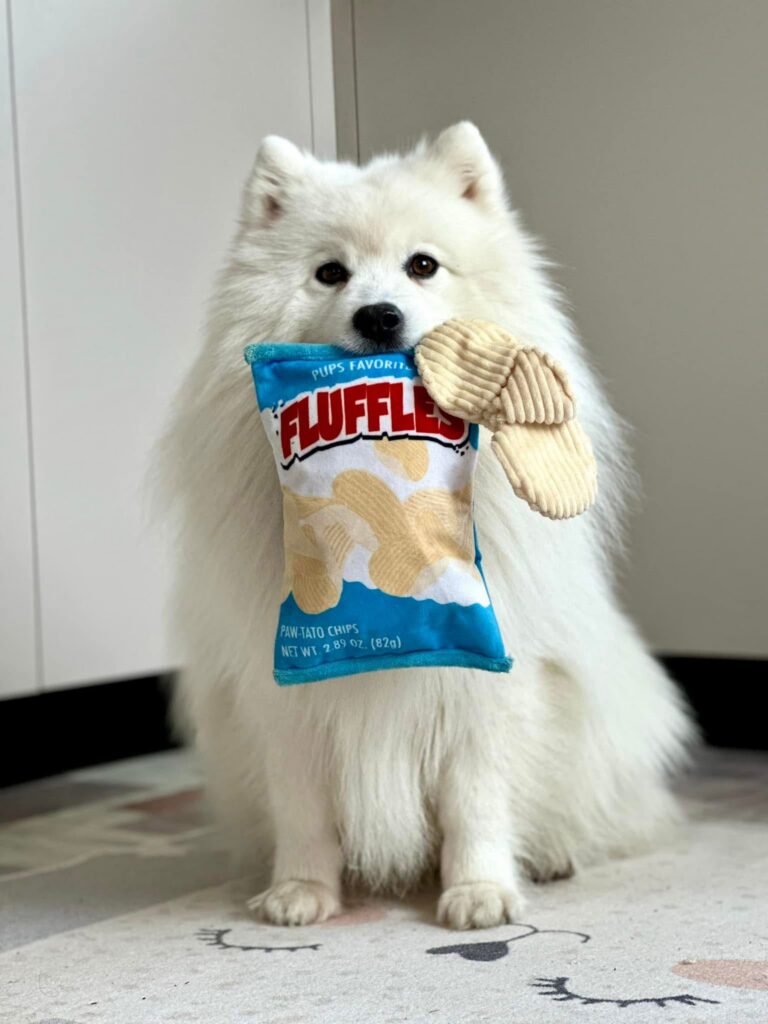
Why Feeding a Japanese Spitz Requires Care
The Japanese Spitz is a small dog, usually weighing between 5 and 10 kg, with a fast metabolism. It uses energy quickly but may also gain weight easily if allowed to eat more than it needs. This must not be underestimated: the breed can be predisposed to patellar luxation, and every unnecessary kilogram places additional strain on the knees. Keeping a Japanese Spitz at a healthy weight is not merely a matter of appearance; it is an important part of protecting its joints.
The breed can also have a sensitive stomach. Japanese Spitz dogs may react poorly to low-quality food, table scraps and sudden dietary changes. Food allergies can cause itching, reddened skin and excessive tearing. Because the coat is white, these problems quickly become visible as rust-coloured tear stains, a dull coat or discolouration in areas that the dog repeatedly licks. In the Japanese Spitz, internal health and outward appearance are closely connected, as I explain in greater detail in our article about coat care.
The conclusion is simple: a Japanese Spitz needs a nutrient-dense, high-quality diet without unnecessary fillers, served in a sensible way. There is no need for miracles or unnecessary complications – only careful attention to the individual dog.
What I Feed My Dogs
I will begin with the specifics, because this is the question I am asked most often. At Byakko Kitsune, Raw Paleo Beef dry food forms the basis of our dogs’ diet, supplemented with Dolina Noteci Super Food wet food. This approach has worked well for our dogs for a long time, and it is one I can recommend with a clear conscience.
Now we come to a point on which I knowingly disagree with half the internet. In our home, dry food is available to the dogs throughout the day, while wet food is served once a day. Most guides insist that a Japanese Spitz should never have permanent access to a bowl of food because it will spread across the floor like rising dough. In many cases, they are right. With my dogs, however, this approach simply works: they eat sensibly, do not overeat and do not try to stock up. They are not greedy.
To be completely honest, this approach will not suit every dog, particularly one that is highly food-motivated. Experience has taught me that. Several puppies became much greedier after moving to their new homes and would immediately empty the entire bowl of dry food. In those cases, I always give the same advice: remove constant access to food and introduce measured portions. That is the most important lesson in this article: observe your dog, not just the feeding chart. If your Japanese Spitz eats moderately and maintains a healthy weight, free access to dry food may be convenient. If it eats as though there will be no food tomorrow, measure its portions and serve them twice a day.
Dry, Wet or Raw Food – Which Approach Should You Choose?
There are several ways to feed a dog, and each can be followed well or poorly. What matters most is quality, not whether the diet is labelled “dry”, “wet” or “BARF”.
Dry food forms the basis of our dogs’ diet and is my first recommendation for most owners. A complete dry food provides balanced nutrition and can be measured precisely, which is particularly valuable in a breed prone to gaining weight. The firm kibble can also help clean the teeth mechanically, as Japanese Spitz dogs tend to accumulate tartar. When choosing dry food, I look for a formula intended for small breeds, with smaller pieces suited to a small mouth, a high meat content and a clearly identified meat source among the first ingredients. My preference is for grain-free food without artificial colours or preservatives.
For us, wet food is an addition rather than the basis of the diet. I use it to provide valuable variety and additional moisture. There is one condition: it must be a high-quality food with a genuine meat content. Cheap tins containing almost everything except meat defeat the purpose.
Raw feeding (BARF) and properly prepared home-cooked diets can produce excellent results, and many breeders use them. However, I make no secret of why I rely on good-quality commercial food: it is balanced and consistent. Preparing a raw diet yourself requires precise mineral and vitamin supplementation. An incorrect balance, particularly of calcium, can permanently affect skeletal development in a growing puppy. This is why I deliberately do not provide recipes based on guesswork. If you want to feed your dog a raw diet, do it properly and under the supervision of a veterinarian or qualified canine nutritionist, rather than following a random graphic found online.
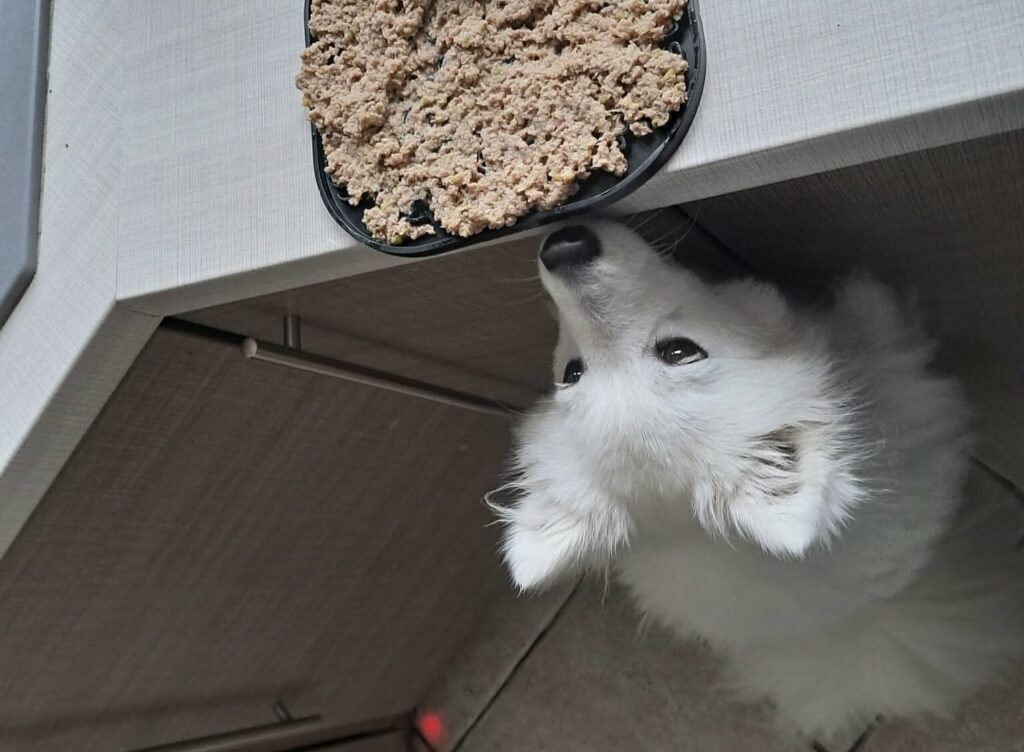
How to Read a Dog Food Label
Knowing how to read a label is more important than attractive packaging. Ingredients are listed in descending order by weight, so those appearing at the beginning of the list make up the greatest proportion of the food.
Ideally, the first ingredient should be a clearly identified source of meat, such as beef, fish, turkey or rabbit, rather than the vague description “meat and animal derivatives”. Omega-3 and omega-6 fatty acids, particularly those provided by salmon oil, are valuable for maintaining healthy skin and the shine and density of the white coat.
What to avoid:
- Grains and excessive fillers, which in our experience can aggravate allergies and digestive problems in Japanese Spitz dogs.
- Animal by-products of poor quality or low digestibility.
- Artificial colours and preservatives, which can affect the texture of the coat and contribute to yellow discolouration.
- Chicken, if the dog develops tear stains or itching – something I will discuss shortly using examples from my own kennel.
Food Allergies – What My Dogs Have Taught Me
This is not something you will find in a breed monograph, because it comes from my own observations as a breeder. My girls – Sayuri, Dorry and Aria – are allergic to poultry, so we consistently avoid it. Aslan, the only male in our group, has no allergies and can eat any good-quality food without difficulty. In practice, my girls receive single-protein foods based on red meat or fish, while Aslan can also eat foods containing poultry. This demonstrates an important point: an allergy is individual to the dog, even among dogs living in the same kennel and family.
How can you tell that something is wrong? Common signs of a food allergy in a Japanese Spitz include itching, scratching, reddened skin, bald patches caused by chewing at the coat and increased tearing, which leaves rust-brown stains beneath the eyes. When the symptoms are mild, the first step is usually to adjust the diet by eliminating the suspected ingredient – most often poultry or grains – and switching to a single-protein food based on fish or lamb.
Consult your veterinarian if the symptoms do not improve after changing the food or if they become more severe – for example, if the dog chews its coat until the skin bleeds, develops sores or secondary infections beneath the eyes, or continues to experience diarrhoea or vomiting. Further investigation may then be necessary, sometimes together with a specialist veterinary diet.
How Many Meals and How Large Should the Portions Be?
Feeding frequency changes as the dog grows older. A puppy begins with five meals a day, gradually moves down to three, and an adult Japanese Spitz is normally fed twice a day. From around eight years of age, a senior dog’s metabolism begins to slow, and its calorie intake usually needs to be reduced slightly to prevent excess weight gain.
The most important question is how to tell whether the portion is appropriate. The answer comes not only from the feeding chart on the bag, but from the dog itself. This can be difficult with a Japanese Spitz because the fluffy coat may conceal both excess weight and insufficient weight. Assess the dog with your hands. In healthy condition, the ribs should be easy to feel without protruding, while a defined waist and an abdominal tuck should be visible when the dog is viewed from above and from the side. If the waist disappears and the ribs are hidden beneath a layer of fat, reduce the portions. If the bones are protruding, increase the amount of food.
As a rough guide, some Japanese breed associations use a formula in which the approximate weight in kilograms corresponds to the dog’s height at the withers in centimetres multiplied by 0.2. For dogs with a stronger and heavier build, the multiplier may be slightly higher. This is only a general indication, not a definitive rule. The dog’s daily calorie requirement is best discussed with a veterinarian because it depends on weight, age, temperament and activity. A Japanese Spitz receiving an hour of exercise each day has different requirements from one training regularly in agility.
One rule is particularly easy to forget: treats count towards the dog’s daily calorie intake. Training rewards should account for no more than 10% of the daily calorie allowance, and the main meals should be reduced accordingly. We use simple treats such as dried beef ears, tripe and small pieces of cooked carrot or pumpkin. For chewing and dental hygiene, we prefer natural chews to artificial alternatives.
Feeding Puppies – From Weaning to Their New Homes
This is what prospective owners ask me about most often, so I will explain exactly how we do it. I begin introducing solid food when the puppies are four weeks old, starting with Raw Paleo Beef pâtés. I then introduce fish, followed from the fifth week by Raw Paleo Puppy Beef dry food, initially soaked in water. Unsoaked dry food is introduced gradually, only when each puppy is ready. I assess this individually, one puppy at a time. By eight weeks of age, the puppies eat five meals a day: two wet meals, served in the morning and evening, and three portions of dry food during the day.
When a puppy leaves for its new home, its starter pack includes a supply of familiar food: 3 kg of Raw Paleo Puppy Beef dry food, four pâtés, two tins of Raw Paleo Fisch and natural dried chews, including a beef ear and tripe. I also include our Happy Puppy Guide, which explains the precise quantities and feeding times. The new owner is not left to work everything out alone.
The most important consideration when a puppy changes homes is that the first few days are extremely stressful. Stress combined with a sudden change of food is a simple recipe for diarrhoea. For the first two weeks in its new home, the puppy should therefore remain on the food it received from us. If the new family later wishes to use a different food, the change should be introduced gradually by mixing the old and new foods for at least a week. In practice, the transition looks approximately like this:
- Days 1–3: approximately 75% of the previous food and 25% of the new food.
- Days 4–6: approximately 50% of each.
- Days 7–9: approximately 25% of the previous food and 75% of the new food.
- Afterwards: complete the transition to the new food.
If the puppy develops digestive problems during the transition, return to the previous stage and wait for its digestion to stabilise. I discuss a puppy’s first days in its new home in greater detail in a separate article about helping a young dog settle in.
Feeding a Bitch During Pregnancy and Lactation
This is primarily a breeding subject, but it is worth understanding because it demonstrates how dramatically nutritional requirements can change. During the first month of pregnancy, the bitch generally eats as she normally would, without major changes. Her requirements increase during the second month, when meals become larger and more frequent. If the diet requires additional support, mineral and vitamin supplementation is introduced in consultation with a veterinarian.
Lactation places the greatest demand on the bitch. A nursing mother, particularly one feeding a large litter, requires a highly nutritious and properly balanced diet with an adequate supply of calcium. Calcium deficiency during this period can lead to postpartum tetany, also known as eclampsia, which is a life-threatening condition. This is the one stage at which strict portion control becomes less important, as the priority is to provide the mother with sufficient energy. Once the puppies have been weaned, we return to normal, controlled feeding.
Foods You Must Never Give Your Dog
Feeding table scraps is a bad idea for reasons beyond weight gain. Some foods commonly found in our kitchens are toxic to dogs, and some can be fatal. Every owner should know the following list:
- Chocolate and cocoa (theobromine) and caffeine.
- Xylitol, an extremely dangerous sweetener found in many “sugar-free” products, chewing gums and sweets.
- Grapes and raisins.
- Onions and garlic, including powdered forms and ingredients in prepared foods.
- Avocado, macadamia nuts, alcohol and raw yeast dough.
- Cooked bones, which become brittle and can pierce the digestive tract (raw chews are a completely different matter).
- Excessive amounts of salt, fat and spicy seasonings, which can place a strain on the kidneys and pancreas.
If your dog eats anything on this list and develops vomiting, diarrhoea, muscle tremors or lethargy, do not wait – seek veterinary assistance immediately. Instead of food intended for people, offer safe alternatives such as cooked carrot or pumpkin, a piece of apple or a small amount of low-fat cottage cheese.
Water – Seemingly Obvious, but Essential
It may sound obvious, but water is one of the most frequently neglected elements of a dog’s care. Fresh, clean water must be available at all times. This is particularly important when feeding dry food, which contains very little moisture. I recommend stable stainless-steel bowls that are easy to clean, with the water replaced regularly. During hot weather and longer journeys, stop to offer water every two to three hours. A Japanese Spitz has a dense double coat, does not tolerate overheating well and can become dehydrated quickly.
Supplementation – When Does It Really Make Sense?
If a dog receives a high-quality, complete food suited to its age, additional supplementation is not usually necessary. Excessive amounts of vitamins or minerals can even be harmful, particularly to a growing puppy. There are, however, situations in which supplements may be appropriate: omega fatty acids from salmon oil to support the skin and white coat; joint supplements containing glucosamine and chondroitin for predisposed or senior dogs; and mineral supplementation for raw or home-prepared diets and for bitches during pregnancy and lactation. The rule is simple: discuss every supplement with your veterinarian. The dog itself is the best indication of whether additional support may be needed – the condition of its coat and the way it moves tell you more than an advertisement.
The Most Common Feeding Mistakes
To finish, here are the mistakes I see most frequently. The first is overfeeding and giving in to the Japanese Spitz’s “smile” – this breed can ask for an extra helping remarkably effectively. The second is treating snacks as though they do not count, even though they contribute to the daily intake just as much as regular meals. The third is ignoring signs of an allergy, particularly around the eyes and on the skin. The fourth is feeding exclusively soft food, which can accelerate tartar accumulation. The fifth is changing food abruptly, which may cause diarrhoea in a dog with a sensitive stomach. The sixth, and the easiest to correct, is failing to provide constant access to fresh water.
The Key Principles at a Glance
The quality of the food matters more than the feeding method. Keep the dog’s weight under control to protect its joints. Assess its condition with your hands, not solely by following a chart. Watch for reactions to poultry and other allergens. Introduce dietary changes gradually. Always provide fresh water. When in doubt, ask your veterinarian rather than the internet.
Frequently Asked Questions
What is the best food for a Japanese Spitz? A high-quality food formulated for small breeds, with a high meat content and preferably without grains or artificial additives. At our kennel, Raw Paleo Beef dry food forms the basis of the diet, supplemented with tins of Dolina Noteci Super Food. What matters most is the quality of the food and its suitability for the individual dog, rather than the name of the feeding method.
How many times a day should a Japanese Spitz be fed? A young puppy eats five meals a day, gradually moving down to three, while an adult dog is normally fed twice a day. A senior dog may require fewer calories as its metabolism slows.
Can a Japanese Spitz eat chicken? Not every dog can. Poultry is a common allergen in the breed. My girls are allergic to it, so we avoid it, while Aslan can eat it without difficulty. If your Japanese Spitz develops tear stains or itchy skin, it may be worth eliminating poultry and switching to another source of protein.
How should a puppy be moved onto a new food? Gradually. During its first two weeks in the new home, keep the puppy on the food provided by the breeder. Afterwards, mix the previous and new foods for at least a week, gradually increasing the proportion of the new food. An abrupt change may cause diarrhoea.
How much should a Japanese Spitz weigh? Usually between 5 and 10 kg, depending on its build. Body condition matters more than the number alone: the ribs should be easy to feel without protruding, and the dog should have a visible waist. Because the fluffy coat conceals the body, condition is best assessed with your hands.
Can a Japanese Spitz have constant access to food? It depends on the individual dog. My dogs eat moderately, so dry food is available to them throughout the day. In a highly food-motivated dog, however, constant access can quickly lead to weight gain. In that situation, I recommend measured portions served twice a day.
Feeding a Japanese Spitz is not difficult if you follow a few straightforward principles and, above all, observe your own dog. To explore the breed more broadly, visit our complete Japanese Spitz guide. If your dog comes from our kennel, you already know that you can contact me directly with any questions about feeding. I am always here to help.
Sources
This article is based on my own breeding experience, specialist veterinary knowledge and official breed standards rather than simplified claims repeated online. Breed standards and monographs focus primarily on the Japanese Spitz’s conformation, temperament and history. The practical feeding information in this article is therefore based mainly on real breeding experience and general knowledge of canine nutrition.
Breeding Experience
- Karolina Grochowiec, breeder of Japanese Spitz dogs at Byakko Kitsune FCI, with many years of experience in caring for, feeding, raising and socialising dogs of this breed.
Official Breed Standards
- Breed Standard No. 262 – Japanese Spitz (PDF) – the Polish translation of the FCI breed standard published by the Polish Kennel Club (ZKwP).
- Polish Kennel Club (ZKwP): Breed Standard No. 262, applicable in Poland.
Books and Monographs
- Marco G. Piasentin, The Japanese Spitz (Zielo Edizioni, Padua, 1997), a comprehensive monograph on the breed, regarded as one of the most important specialist sources.
- Miwako Okada, Spitz Bible (スピッツバイブル), a Japanese publication devoted to the development of the breed in its country of origin.