
Japanese Spitz vs Samoyed – A Comparison of Two Charming Spitz Breeds
A Common Ancestor, Separate Paths
We hear it regularly while out walking: “Oh, a little Samoyed!” The Japanese Spitz and the Samoyed really can look like the same breed in two different sizes. Both are snow-white, both appear to “smile”, and both carry a plumed tail over the back. Yet this resemblance is deceptive. They share a distant common ancestor among the white dogs of the north, but their paths diverged long ago and produced two very different breeds. In this comparison of the Japanese Spitz and the Samoyed, we focus on the most important point: almost every difference between them can be traced back to their history and the purpose for which each breed was originally developed.
The Samoyed is an ancient breed. It was developed by the nomadic Samoyedic peoples of frozen Siberia, particularly the Nenets. For centuries, these dogs herded reindeer, pulled sledges and assisted with hunting. At night, they slept in yurts and kept children warm like living hot-water bottles. This centuries-long closeness to people became deeply rooted in the breed’s nature.
By comparison, the Japanese Spitz is a very young breed. It was developed in Japan during the first half of the twentieth century, between the 1920s and 1950s, from white Spitz dogs imported from different parts of the world. Japanese breeders created a companion dog that, during the difficult post-war years, also served as an alert system in the home. One breed therefore developed in the Arctic wilderness for demanding work, while the other was created in Japanese homes for companionship and to watch over the household. This is where the differences that follow begin.
Size – the First Difference You Notice
This is the most obvious difference between the breeds. The Samoyed is a medium-sized dog: males stand approximately 57 cm at the withers and females approximately 53 cm, while their weight usually ranges from 20 to 30 kg. Beneath the abundant coat lies a heavier bone structure than its appearance might suggest – a legacy of the breed’s work in harness.
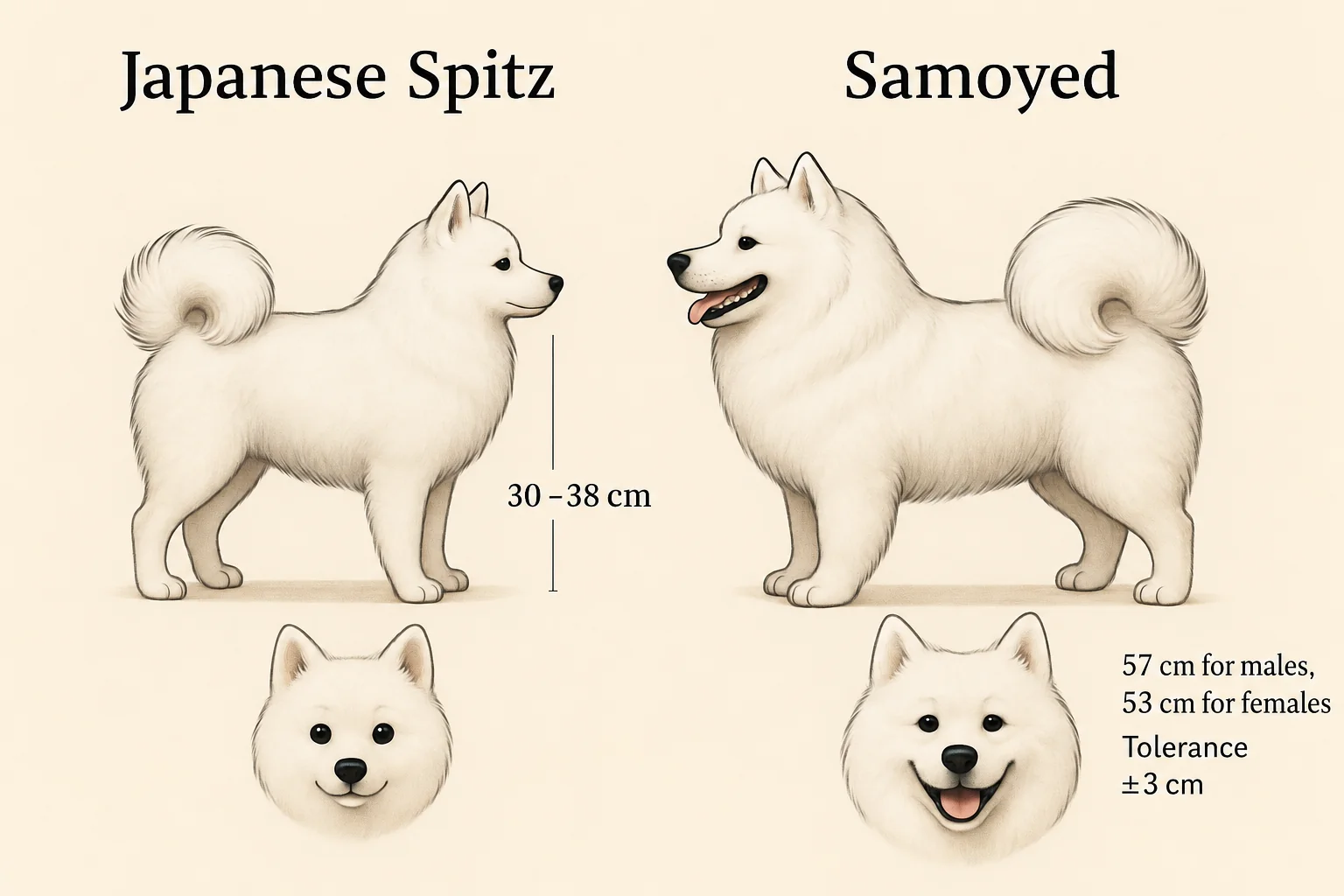
The Japanese Spitz is considerably smaller. According to the FCI breed standard, males stand approximately 30–38 cm at the withers, while the breed generally weighs around 5–10 kg. The Japanese Spitz never pulled sledges or worked in Arctic conditions, so it had no need for the same physical mass. The northern heritage of both breeds remains visible in their appearance: a fox-like, pointed muzzle, small erect ears and a plumed tail carried over the back. In the Samoyed, the tail also served a practical purpose, as the dog could cover its nose with it while sleeping and warm the air it inhaled. In the Japanese Spitz, it is primarily an elegant hallmark of the breed.
The Smile and the White Coat – Two Features That Are No Accident
Both breeds appear to “smile”, but their characteristic expressions have different origins. In the Samoyed, the famous “Sammy smile” is created by dark, obliquely set eyes and the slightly upturned corners of the black lips. This served a practical purpose: the shape of the mouth helped prevent saliva from dripping and freezing on the muzzle in the Siberian cold. In the Japanese Spitz, the smile acquired a more cultural meaning. In Japan, it was seen as a reflection of the dog’s cheerful nature, and this joyful expression contributed greatly to the breed’s popularity as a companion.
The coats of both breeds function in a similar way. Each has a double coat, with a dense, woolly undercoat beneath a harsher outer coat. It provides insulation from both cold and heat, has self-cleaning properties and carries little of the typical doggy odour. Once dry, much of the mud simply falls away. There is, however, an important difference between the breed standards. In addition to pure white, the Samoyed may be cream or white and biscuit. The Japanese Spitz standard permits only pure white, and any other colour is considered a fault. One important principle applies to both breeds: their coats should never be shaved, because the same structure that protects them from the cold also helps to insulate them from heat.
Temperament – Where Their Histories Make the Greatest Difference
In temperament, the two breeds have a surprising amount in common. Both are friendly and generally non-aggressive towards people because each was shaped by close contact with humans: the Samoyed through centuries of living alongside the Samoyedic peoples, and the Japanese Spitz from its earliest generations as a deliberately developed companion breed. Both are intelligent, but each also possesses an independent streak. They are not blindly obedient dogs; they consider whether a request makes sense and respond better to encouragement than coercion. Both cope poorly with prolonged solitude because they are naturally social and want to remain close to their people. The Japanese Spitz and the Samoyed are also sensitive to tone of voice, so shouting and harsh treatment may cause them to withdraw.
The clearest difference concerns guarding the home, and it follows directly from the breeds’ original purposes. The Samoyed is entirely unsuited to being a guard dog: it tends to greet strangers enthusiastically, and centuries of working alongside people and other dogs encouraged cooperation rather than suspicion. The Japanese Spitz, by contrast, is an alert watchdog that will announce an unfamiliar presence with loud barking, although without aggression. In post-war Japan, this tendency was considered an advantage because the dog acted as a living household alarm. The breeds also differ in their attitude towards strangers. A Samoyed is likely to welcome almost everyone as a friend, while a Japanese Spitz may initially be reserved and need a little time to accept a new person. We discuss further nuances of the breed’s temperament in our article about the different types of Japanese Spitz.
Exercise and Grooming – How Demanding Is Each Breed?
In practice, this area may determine which breed is compatible with your lifestyle. The Samoyed is a hardy working dog, not a couch potato. It needs two long walks each day and is particularly well suited to activities such as canicross, bikejoring and dog trekking. A garden alone will not tire a Samoyed, as the dog will simply become bored without purposeful activity. Its coat is also among the most demanding to maintain. It requires brushing at least once a week and often every day during periods of heavy moulting. Bathing and thoroughly drying the coat can take several hours, and not every groomer is prepared to work with it.
The Japanese Spitz is less demanding in this respect. Around an hour of daily exercise is generally sufficient, often provided through one longer outing or two shorter walks, and the breed can adapt very well to life in a flat. Its “Teflon-like” coat also makes everyday care considerably easier. Brushing is usually needed one to three times a week, bathing only once every few months, and most owners can manage the grooming themselves. The two breeds share one limitation: neither copes particularly well with hot weather. During summer, walks should take place in the early morning or evening, while the dogs should have a cool place to rest and constant access to fresh water.
Health, Life Expectancy and Costs
Both breeds are considered relatively healthy and long-lived, although their health profiles differ. The Japanese Spitz typically lives for around 12–16 years and is regarded as a particularly hardy breed. Patellar luxation is among the conditions most often mentioned, although it occurs less frequently than in many other small breeds, and some dogs are prone to tear staining. The Samoyed generally lives for 12–14 years. Its recognised predispositions include joint dysplasia, eye conditions, diabetes and an increased risk of gastric torsion associated with its deep chest. Diabetes is reported more frequently in the Samoyed than in other northern breeds.
The costs present an interesting contrast. In Poland, a Japanese Spitz puppy from an FCI-registered kennel generally costs around PLN 7,000–10,000, while monthly maintenance costs are approximately PLN 200–300. A Samoyed may be slightly less expensive to purchase but is often more costly to maintain, principally because of its demanding coat and sensitive digestive system. The same rule should apply in both cases: choose a puppy only from a kennel registered with ZKwP within the FCI system, and from a breeder who health-tests the parents and provides the relevant documentation. You can meet our dogs and view information about their health examinations on their individual pages.
Which Breed Is Right for You?
Neither breed is inherently better than the other; the right choice depends on which one suits a particular person and lifestyle.
A Samoyed may suit you if:
- you lead a very active life, enjoy running, cycling or mountain hiking, and want a canine sports partner;
- you have time for regular and demanding coat care;
- you are comfortable with a vocal dog and do not need a watchdog.
A Japanese Spitz may suit you if:
- you live in a flat or have a smaller home;
- you want a family companion that can live happily with children and older people;
- you value an alert watchdog and want a coat that is easier to maintain.
There are, however, two shared traits to consider: neither breed copes well with prolonged solitude, while the Japanese Spitz can also be prone to barking. One point deserves to be stated clearly: the Japanese Spitz is not a “small Samoyed”. It is a distinct breed with a different size, structure and original purpose. The two share a distant common ancestor, but the Japanese Spitz did not develop directly from the Samoyed. Choosing between them is therefore largely a choice between two lifestyles: an endurance partner for sport and adventure, or a smaller household companion and alert watchdog.
Frequently Asked Questions
How Does the Japanese Spitz Differ from the Samoyed?
The greatest differences lie in size and original purpose. The Samoyed is a medium-sized dog weighing approximately 20–30 kg. It was developed in Siberia for work in harness and is generally unsuitable as a guard dog. The Japanese Spitz is much smaller, usually weighing around 5–10 kg. It was developed in Japan as a companion and acts as an alert watchdog, announcing unfamiliar activity with its bark. The breeds share a distant ancestor among the white dogs of the north.
Which Breed Is Better Suited to an Active Lifestyle?
The Samoyed is the clear choice for a highly active lifestyle. It is a hardy working dog developed for running and pulling, is well suited to sports such as canicross and bikejoring, and needs two long walks each day. The Japanese Spitz is active too, but around an hour of daily exercise is generally sufficient. For a committed runner or cyclist, the Samoyed is likely to be the more suitable partner.
Is the Japanese Spitz a Small Samoyed?
No. Despite their striking resemblance, they are two distinct breeds with different structures and histories. They share a distant common ancestor among the northern Spitz breeds, but the Japanese Spitz is not descended from the Samoyed and has a different bone structure and original purpose.
Which Breed Is Easier to Groom?
Definitely the Japanese Spitz. Its “Teflon-like” coat sheds much of its dirt once dry, usually needs brushing one to three times a week and requires bathing only once every few months. The Samoyed has one of the most demanding coats to maintain: daily brushing may be necessary during periods of heavy moulting, while thoroughly drying the coat after a bath can take several hours.
Which Breed Is Better Suited to Life in a Flat?
The Japanese Spitz is generally better suited to life in a flat because of its compact size and ability to settle calmly indoors. Its tendency to bark must nevertheless be taken into account. As a larger and more demanding working breed, the Samoyed needs considerably more exercise and may find a confined living space more challenging.
Which Breed Lives Longer?
Both breeds are relatively long-lived. The Japanese Spitz generally lives for around 12–16 years, while the Samoyed typically lives for 12–14 years. Statistically, the Japanese Spitz may reach a slightly greater age, although responsible breeding and appropriate lifelong care are crucial in both breeds.
Thinking of welcoming a Japanese Spitz into your home? Meet our puppies and get to know the breed more closely.
Would you like to learn about the breed from the beginning? Explore our comprehensive Japanese Spitz guide.