
Japanese Spitz Grooming – Coat Care, Moulting and a Breeder’s Routine
Whenever I tell people that I share my home with four white dogs, the first question is always the same: “How do you manage? You must spend your life with a vacuum cleaner in your hand.” I understand the reaction. A snow-white coat with a dense undercoat sounds like a recipe for endless work. I thought much the same before Sayuri came to live with us. Today, after several years of breeding Japanese Spitz, I know that their coat works very differently from that of many other dogs. This often works in our favour – but only when we understand how the coat functions and what it genuinely needs.
The Japanese Spitz Coat – How It Is Structured and Why It Matters
Two Layers, One Precise System
FCI Standard No. 262 describes the Japanese Spitz coat in considerable detail, showing that its structure is anything but accidental. It is a double coat: the outer coat is straight and stand-off, while the undercoat is short, soft and dense. The two layers do not function independently; together, they form a carefully balanced system.
The length of the coat varies across the body. It is short on the muzzle, ears, fronts of the forelegs and below the hocks, while the rest of the body is covered with abundant, longer hair. The magnificent ruff extending from the neck across the shoulders and forechest is one of the breed’s most distinctive features, and the tail carries long, profuse feathering. The only permitted colour is pure white, without cream or biscuit shading.
A Coat That Almost Cleans Itself
This quality surprises almost every new owner. The Japanese Spitz coat is often described as “self-cleaning” and compared to Teflon. The comparison is figurative, but it reflects a genuine practical advantage: the smooth, stand-off guard hairs do not hold dry dirt easily, while the coat’s natural surface oils help water bead and run off rather than soaking in immediately.
In practice, a Japanese Spitz returning from a rainy walk is often wet mainly on the surface. After towel-drying, a few vigorous shakes and sufficient time to dry, the coat regains its volume. Mud behaves in much the same way: once dry, much of it falls away or can be brushed out easily. Compared with many other breeds, Japanese Spitz also tend to have very little of the characteristic “doggy” odour, even when wet.
There is, however, one important exception: the dense coat can collect grass seeds and sharp awns. After every walk through long grass, check the coat carefully, paying particular attention to the ears, paws and spaces between the toes. Removing them promptly helps prevent awns from working their way into the skin.
The Undercoat – The Framework That Changes Everything
The undercoat forms the foundation of the entire coat. Its density supports the outer coat and makes it stand away from the body, giving the dog its characteristic cloud-like appearance. When the undercoat is full, the outline looks abundant and impressive. At the height of a moult, much of that volume may disappear and the dog can look surprisingly sparse. Breeders sometimes describe this bluntly as a “moth-eaten” appearance. The transformation can be startling to anyone seeing a Japanese Spitz in full moult for the first time.
Indoor living, artificial light and centrally heated rooms can make the natural moulting pattern less clearly seasonal. Instead of one or two very intensive moults, some dogs lose smaller amounts of undercoat over a longer part of the year. These dogs benefit from regular brushing every few days to remove loose hair before it begins to accumulate.
Male and Female Coats – Differences and Stages of Development
Males generally carry a fuller, more imposing coat than females, particularly around the ruff, which is usually broader and more profuse. Females often have a less abundant coat and a more delicate, fox-like expression. This does not make their appearance less attractive – only differently proportioned. In females, coat condition is also influenced by hormonal changes. A season, pregnancy and rearing puppies may trigger a sudden loss of undercoat outside the usual moulting cycle.
The Japanese Spitz coat changes considerably as the dog matures. A newborn puppy is covered with short, soft white down and has folded ears. Pigmentation of the nose, eye rims and paw pads may continue to develop during the first days and weeks of life. At around five or six weeks, the coat becomes longer and softer, giving the puppy its teddy-bear appearance. The emerging adult coat can be assessed more reliably from approximately eight to ten months, although development is far from complete at that age. Many Japanese Spitz do not achieve the full richness of their mature coat until around two or three years of age, and its quality may continue to develop as the dog matures.
Everyday Grooming of the Japanese Spitz
Brushing – A Routine That Makes a Difference
Outside the main moulting periods, the Japanese Spitz coat needs regular but not excessive brushing. For most family dogs, two or three thorough sessions a week are a sensible starting point, although the ideal frequency depends on coat density, lifestyle and the amount of loose undercoat. Marco Piasentin, author of a monograph on the breed, recommends brushing every one or two days when the aim is to maintain the coat in show condition.
I prefer not to brush a completely dry coat. A light mist of water mixed with a small amount of suitable anti-static conditioner helps reduce static and friction, making the hair easier to work through without unnecessary breakage. The coat should be lightly dampened rather than soaked, and any grooming product should be diluted and used according to the manufacturer’s instructions.
The coat should be brushed in sections, working through each layer from the skin to the ends rather than skimming over the surface. I begin behind the head and continue gradually along the body towards the tail, removing loose hair and checking for tangles as I go. I then work in the opposite direction, brushing gently against the natural lie of the coat from the tail towards the head to restore its characteristic volume. Use short, controlled strokes and take particular care behind the ears and around the thighs, where the skin is sensitive and tangles form most readily.
Essential Grooming Tools – What You Really Need
Regular grooming requires a small selection of well-chosen tools. A pin brush with smooth, rounded pins and no plastic caps is useful for routine brushing and restoring volume. A good-quality slicker brush helps remove loose undercoat, while a metal comb with both widely and closely spaced teeth allows you to check your work and reach delicate areas behind the ears. A rotating-pin undercoat rake can help separate compacted undercoat during a heavy moult. A dematting tool should be kept for occasional, careful use when a genuine mat has formed, rather than used routinely across the coat. A natural-bristle brush can be useful for finishing the surface and distributing the coat’s natural oils.
Bathing – Less Often Than You Might Think
This is where the coat’s dirt-repelling qualities work strongly in our favour. Marco Piasentin suggests that Japanese Spitz living away from heavy urban pollution may need bathing only twice a year, while dogs living in cities may benefit from a bath every two or three months. In practice, there is no universal schedule: a dog should be bathed when its coat or skin genuinely requires it. For many family dogs, bathing approximately once every few months provides a useful starting point rather than a rigid rule.
Why are frequent baths often unnecessary? Once dry, mud can usually be brushed out and much everyday dirt simply falls away. Repeated washing with an unsuitable shampoo, poor dilution or inadequate rinsing may strip protective oils from the skin and coat, leading to dryness and affecting the texture of the hair. When a bath is needed, however, correctly selected products and thorough rinsing are more important than following an inflexible calendar.
Bathing a Japanese Spitz has one technical difficulty: the coat repels water. To wet it thoroughly, I direct the stream of water from close up and at the same time knead the coat with my hands so that the liquid reaches the skin. Shampoo – always mild, protein or whitening, diluted before application. I avoid oily cosmetics – over time, these yellow the white coat, and reversing this effect is tedious.
Drying is the most important stage of the whole bath. Under-dried undercoat is a straight path to chafing, skin inflammations and lightning-fast matting of the fur. A hair dryer with lukewarm – not hot – air, held at a distance of at least twenty-five centimetres, and simultaneous brushing „against the grain”. The dog should not lie down while the coat is still warm – otherwise we will ruin the result of all our hard work.
Clipping the Coat – The Short Answer Is No
The Japanese Spitz coat should not be routinely shaved or clipped short for cosmetic reasons. Removing the double coat can interfere with its protective function, expose the skin more directly to the sun and weather, and result in slow, uneven or altered regrowth. Clipping may occasionally be required for veterinary examination or treatment, but it is not part of normal grooming for the breed.
Light tidying with scissors is possible in a few specific areas, provided that it does not alter the dog’s natural outline. Hair around the paws may be neatened to reveal their compact, rounded appearance, while excess hair between the pads can be shortened when it becomes long enough to trap dirt, form tangles or reduce grip. Stray hairs extending beyond the natural outline of the ears may be carefully trimmed to emphasise their small, triangular shape. The ends of the tail feathering can also be lightly evened if necessary. Any hygienic trimming should be minimal and performed only where it genuinely improves cleanliness and comfort.
For this limited tidying, straight grooming scissors, round-tipped scissors and thinning scissors are usually sufficient. They should be used carefully and only by someone confident in handling them safely around a moving dog. A Japanese Spitz does not need regular visits to a groomer for a styled “haircut”, although a knowledgeable professional can help with bathing, drying and removing loose undercoat.
What to Watch For – Common Coat and Skin Problems
Many common coat problems in the Japanese Spitz result from unsuitable grooming or neglected maintenance rather than an inherent defect in the hair itself. Excessive washing with harsh products may dry the skin, while rough brushing can create static and contribute to breakage. When loose undercoat is not removed, tangles may tighten into mats that pull painfully on the skin and trap moisture and dirt. This can cause irritation and inflammation, and persistent scratching or chewing may lead to further injury.
Dogs prone to excessive tearing need particular attention around the eyes. Reddish-brown staining is highly visible against a white coat, while constantly damp hair may irritate the skin and increase the risk of infection. Gently clean and dry the area with a product that is safe for use around the eyes. Sudden, persistent or excessive tearing – especially when accompanied by redness, discomfort or discharge – should be assessed by a vet rather than treated as a purely cosmetic problem.
Managing the Japanese Spitz Moult
“A Fur Explosion” – Why the First Moult Can Be a Shock
The first heavy moult can surprise even experienced dog owners. Breeders often call this process “blowing the coat”, meaning the rapid release of a large amount of undercoat. Many adult Japanese Spitz have one or two pronounced moulting periods each year, although their frequency, timing and duration vary with sex, hormones, climate and living conditions. A heavy moult often lasts several weeks and may involve the loss of a substantial proportion of the soft, woolly undercoat.
The coat does not always come out one hair at a time – during a heavy moult, it may be released in soft clumps. You will find it on clothes, furniture and, occasionally, even in your food. As the undercoat disappears, the dog loses much of its characteristic volume and may look surprisingly slim compared with its usual appearance. If you see a Japanese Spitz at the height of a moult without knowing what to expect, the transformation can be alarming.
The process usually develops gradually. Loose undercoat begins to lift away from the skin and should be removed regularly before it compacts or tangles. A smaller amount of outer coat may also be lost during the same period. New growth then restores the coat’s density and characteristic stand-off appearance, but the return to full condition takes time and varies from dog to dog.
Grooming During a Heavy Moult
During a heavy moult, the dog usually benefits from daily brushing. Short, gentle sessions are often more comfortable and effective than trying to remove all the loose undercoat at once. Brushing does not stop the biological moulting process, but it collects released hair before it reaches the furniture and helps prevent loose undercoat from compacting. Lightly misting the coat before brushing can also reduce static and unnecessary breakage.
A bath during a heavy moult can help loosen undercoat that is already ready to come away. If you bathe the dog at this stage, thorough drying is essential. A suitable high-velocity dryer can blow out a considerable amount of loose undercoat, while careful brushing during drying helps separate the remaining layers and reduces the risk of tangles.
During this period, a good-quality slicker brush and pin brush are particularly useful for removing loose undercoat in controlled sections. A rotating-pin undercoat rake can help separate denser areas without dragging unnecessarily on the coat. Finish with a metal comb to check that no compacted patches remain. A dematting tool should be reserved for genuine mats and used cautiously to avoid cutting healthy coat or skin.
Females May Moult Differently from Males
This is particularly important for owners of breeding females. Hormonal changes associated with a season, pregnancy and nursing puppies may trigger additional episodes of heavy coat loss unrelated to the time of year. After the puppies have been weaned, a female may lose a large proportion of her undercoat over a relatively short period. Although the change can look dramatic, it is a familiar part of the reproductive cycle in many double-coated females.
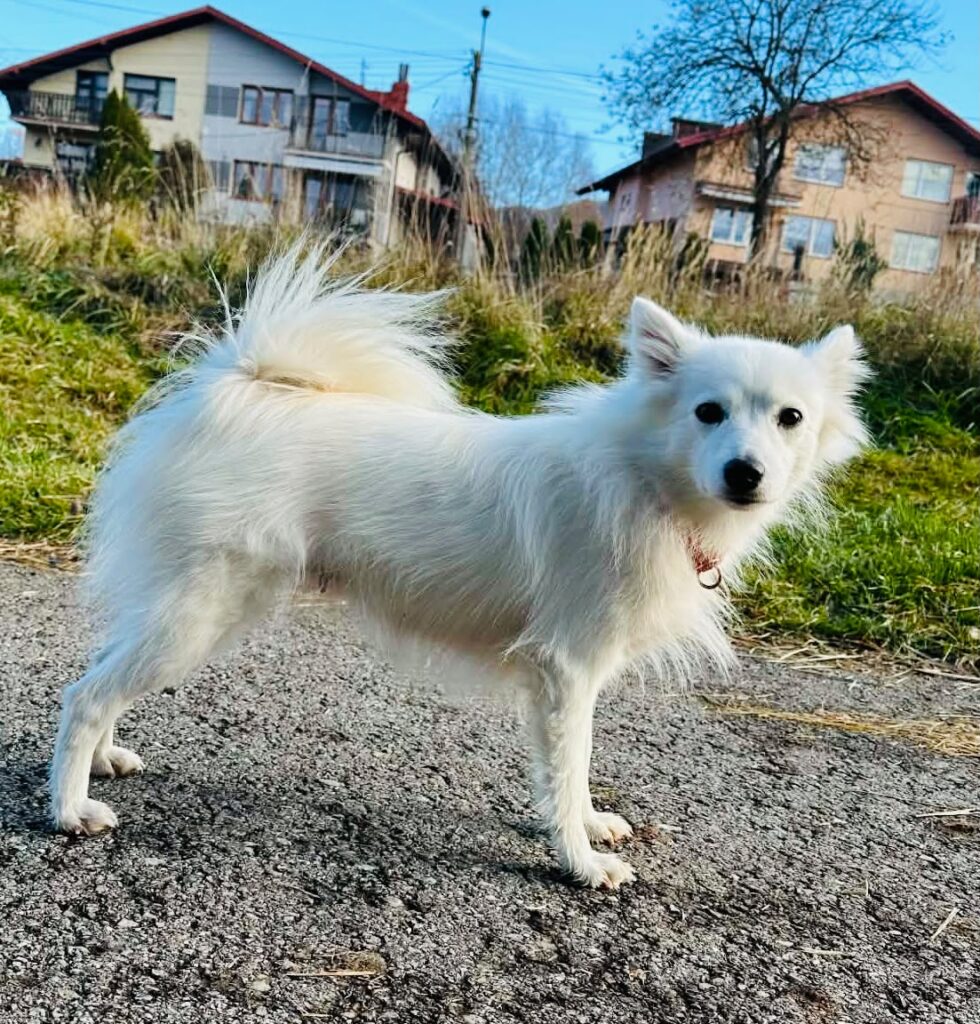
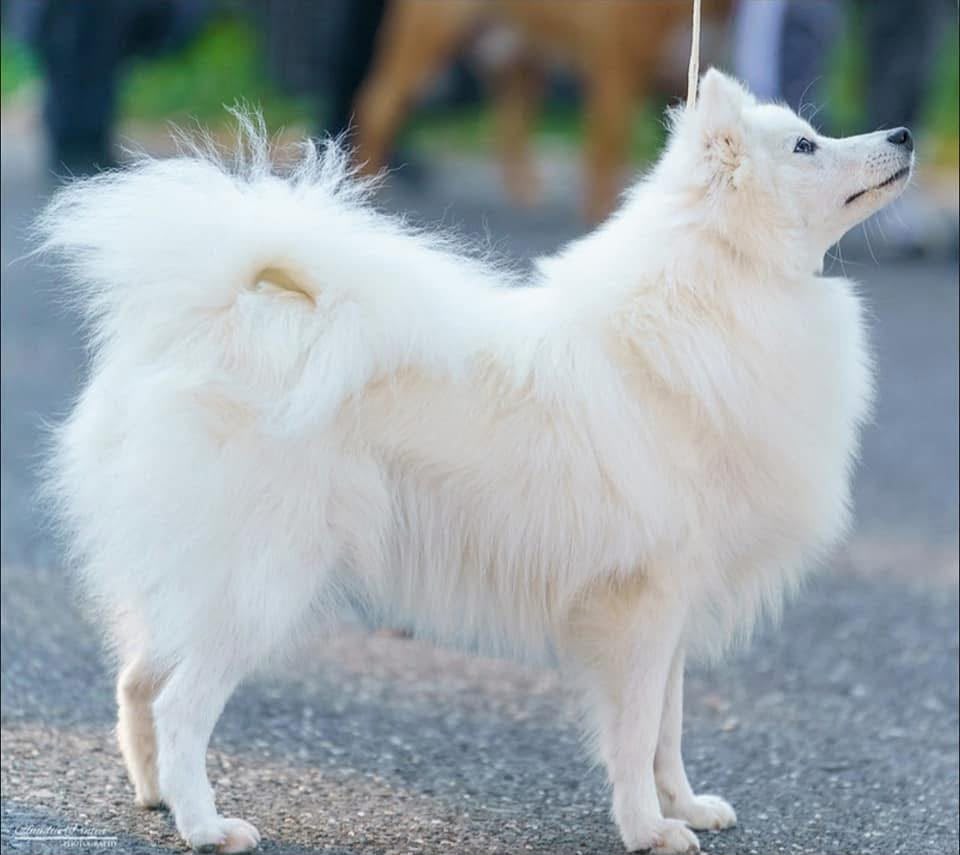
Males often follow a more recognisable seasonal pattern because their coat cycle is not affected by seasons, pregnancy or lactation. Their mature coat is also generally fuller throughout the year, particularly around the ruff. Individual variation remains considerable, however, and indoor living may make even a male’s moulting pattern less clearly seasonal.
Living in heated rooms can make the natural cycle less distinct in dogs of either sex. Instead of one or two concentrated moults, some Japanese Spitz lose smaller amounts of undercoat throughout much of the year. This calls for consistent brushing every few days, but may also mean that there is no single dramatic “fur explosion” to manage.
Preparing the White Coat for a Show
Show preparation has its own rhythm. In our routine, we usually bathe a Japanese Spitz three or four days before the show rather than the evening before it. Immediately after washing, the coat may be softer and flatter than desired; allowing a few days for its natural texture and volume to return often produces a better result. The ideal timing depends on the individual dog, the condition of the coat and the products used, so it is worth testing the routine well before an important show.
Choose products formulated for white, double-coated dogs and suited to the individual dog’s skin. Protein-based or brightening shampoos may help improve the coat’s appearance, but they should be used and diluted as directed. I avoid heavy, oil-rich products before a show because they can weigh down the coat and reduce its crisp, stand-off texture. Suitable grooming powders can help freshen small areas, improve the visual brightness of the coat and add texture before presentation, provided that they are used responsibly and in accordance with show regulations.
Tear staining is one of the most visible cosmetic challenges in a white dog. Gentle, regular cleaning and careful drying of the eye area are far more effective than trying to remove established staining during the week before a show. Persistent or excessive tearing should be investigated by a vet, because grooming alone cannot resolve an underlying medical cause.
One small detail can also make a visible difference in the ring. When choosing a show lead for a white dog, avoid one that is stark white or considerably lighter than the coat. The contrast may make even a clean white coat appear cream or grey. A coloured lead allows the dog’s natural shade to be judged without that misleading comparison. Our shop offers handmade show leads in a range of colours, and we will be happy to help you select a suitable shade.
To learn more about the conformation and appearance of the Japanese Spitz under the FCI breed standard, read our detailed guide to the appearance of the Japanese Spitz. If you are still deciding whether the breed suits you and your lifestyle, return to our complete Japanese Spitz guide.
Sources
- FCI Standard No. 262 – Japanese Spitz (English PDF) – the official Fédération Cynologique Internationale breed standard.
- Marco Piasentin, Japanese Spitz.
- Miwako Okada, Spitz Bible (スピッツバイブル) – a Japanese publication dedicated to the history and development of the breed in its homeland.
- Original work and breeding observations by Byakko Kitsune FCI, informed by official breed standards, specialist cynological literature and our own experience with the Japanese Spitz.