
Safe socialisation and ENS – the first weeks of a puppy's life in my kennel
My breeding approach
In my kennel, every puppy receives care, affection and attentive support from the very first days of life, with a focus not only on physical development but, above all, on emotional development. That is why socialisation is one of the foundations of my work, rather than simply an “extra” introduced after weaning. In this post, I share my gentle, thoughtful approach to puppy socialisation, which respects each puppy’s natural pace of development.
Socialisation starts in the whelping pen
Many owners believe that socialisation only begins after eight weeks of age, when a puppy joins its new family. In fact, it starts much earlier, with the first experiences of a human voice, scent and touch. In my kennel, daily human contact begins on the very first day of life. Being weighed, held and gently stroked are all important early experiences.
Respect for the rhythm of the mother and puppies
I avoid anything that might unsettle the mother. I do not separate the puppies from her unnecessarily or overstimulate them with light or sound. I approach every step with care, observing how both the mother and her puppies respond.
My approach to ENS
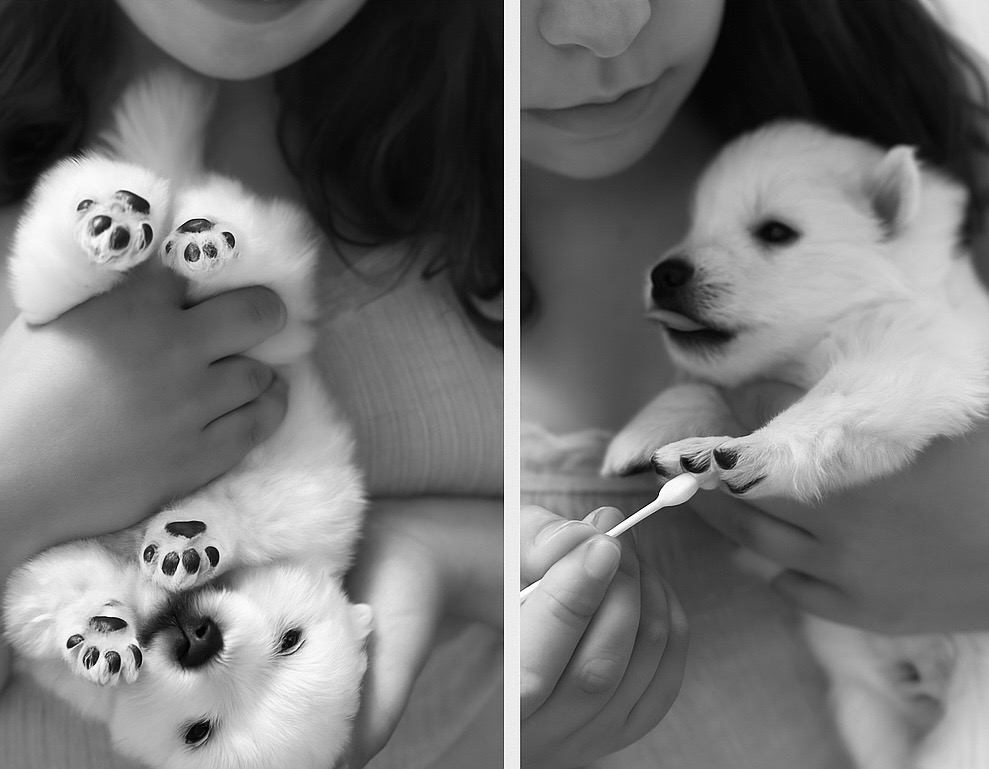
Although the standard Early Neurological Stimulation (ENS) protocol begins on day three of life, in my Japanese Spitz kennel I introduce my adapted version at around two weeks of age. Why? By then, the puppies are more aware of their surroundings, and their mother feels secure. I keep these sessions gentle and unhurried, treating them as moments of closeness rather than a task to tick off.
In my adapted version of ENS, I use five exercises: gently touching the paws, holding the puppy upright with the head up, holding the puppy with the head down, holding the puppy on their back, and brief contact with a cool surface. Each exercise lasts only a few seconds and is adjusted to the puppy’s comfort.
Socialisation is an approach, not a to-do list
I believe that good socialisation is more than a programme. Above all, it is an approach to caring for puppies with empathy, attentiveness and respect for their natural needs. It is a daily ritual that builds trust and emotional resilience. In my kennel, every puppy grows up in a calm environment with close human contact from the very beginning, helping them develop into a confident, well-adjusted companion.
Karolina Grochowiec